

Hired Guns
There is no shortage of opportunity in The Bary for the unscrupulous. Hired guns resolve disputes with the threat or application of force.

A Hope and Spiral
It’s a big, black sky out there. Like the hired swords of old, the hired guns of the present tame the wilderness between worlds. There is no shortage of opportunity in The Bary for the unscrupulous. To protect traffic and tradelane, reliance on traditional navies and law enforcement does not prove wholly successful in all circumstances. Public and private interests alike often turn to private military companies, privateers, or interdictors to bolster their security.
As deep space voidflight moved beyond the purview of academic endeavor and shear drives came into common use, it was believed policing the aether would remain a mundane task. For one thing, shear drives and their reactors burn bright, rendering every such-equipped vessel a glowing beacon in transit and well-illuminated while idle. Because brachistochrone trajectories between points of interest are known by anyone with a standard navigation computer, as are optimal fuel-saving slingshot maneuvers, surely any suspicious activity could be spotted and avoided from millions of kilometers away.
Piracy, once a challenge for companies and state navies alike on the high seas of ocean-bearing worlds such as Maridea, Castor, and Pollux (to a lesser extent also on the inland seas of Sibyl and over the sands of Sebek), was to become a mere nuisance for any interplanetary convoy with a modicum of preparation and awareness. Science fiction authors had their fantasies about illicit activity and warfare in space, but for academic think tanks, violence on the scale of brawling vessels at sea was unthinkable. For futurists and risk managers, interplanetary piracy was largely a fanciful thought experiment confined to remote worlds and outposts where defense sometimes takes a backseat to survival. In such cases, there were always ways to buttress an outpost or settlement’s fortification against raids. Many were built underground for protection against stellar radiation anyway.
For a century or more, there was a belief, however wavering, in space as a higher plane of human cooperation and enlightenment. The Barystates had found each other, and found each other strange. Despite their differences, surely the future of humanity in the vacuum lay in trade, research, exploration, and cooperation. The great hollow of the black was far too vast for anything else.
This conjecture was perhaps a convenient forgetting of how early interplanetary contact scenarios had ultimately played out. Although none of those landings directly led to conflict on the ground or in the sky above, they frequently led to ruffled feathers. Just ask a Celadonian, or a historian of early relations between the two Dominion sister worlds.
Wherever humanity goes, it brings a force of will. Conflict is never inevitable, but it is always possible. When the first interstellar hostilities began, the war between the Novani Republic and the Sibylean Commonwealth shattered a century of tenuous hope placed in keeping the aether and the paths between sacrosanct.
A humiliating defeat for Novani imperial ambitions and an accelerant of the Republic’s devolution, the Novani-Sibylean War had another outcome: proving to the masses that space itself held no ideals. The war itself did not lead to an increase in voidborne crime—the void was still impossible for the average individual to access. Rather, its long-term psychological effect on future space travel over the next century would be pronounced. Defense budgets universally rose, and nascent space navies grew, all while wealthier private interests began investing in transit security where there had been little such concern before.
Trade Security
Thirteen years after the cessation of that war, the first Interstellar Congress convened in part to discuss these issues. The Barystates made an honest attempt to smooth over differences and erect reasonable guardrails on trade, immigration, and the use of force in space.
At the successful conclusion of the first Congress, the Empyreans offered the other Barystates a momentous gift. By virtue of their vast size and engine efficiency, Empyrean-built Titan-class mega-freighters opened up regular trade between opposite ends of The Bary—at least to anyone with patience still often measured in years. Ferrying many megatons of varied sealed, containerized, bulk, and even organic freight, Titans proved invaluable to every soul up and down the economic ladder. They gave desolate worlds like Sibyl and Sebek room to grow, and in return the garden worlds such as Maridea and Leire received unique alloys, rare materials like erudium, fusion fuels, durable goods and manufacturing supplies, and even hardier breeds of livestock. Trade missions ramped up their scope considerably. Cultural exchange and the trade of goods flourished.
Immediately recognizing the significance of these majestic vessels, the recipient Barystates began attaching flotillas of escort cruisers to them, just to be absolutely confident of their safety crossing the deepest depths of the void during their multi-year journey.
But despite cutting the costs of long-haul shipping dramatically, the new Empyrean monopoly on deep space trade unsettled entrepreneurs. Titans to this day remain solely built by the Conglomerate. They spend much of their time traveling through Empyrean volumes of space. The inscrutable but honorable Empyreans quickly became a reputable escrow partner for international transactions of all kinds—a thalassocracy not seen since the ancient Castori merchant republic of Riga dominated the West and East Calaisean Seas. All these factors gave Titans priority protection from the four respective navies of The Bary and left private interests that wished for more discretion in their business affairs alone to fend for themselves.
Then, in 79 CY, the Anomaly appeared, shrouding large volumes of space throughout The Bary and beyond in an abyssal hollow stranger than the void itself.
The shattering of known space had two effects, one instantaneous and one that took some more time to be realized.
In the first place, freebooters, smugglers, and outlaws immediately found far more places in which to hide themselves from authorities, given that no conceivable sensor system has line of sight through The Anomaly. (To this day, sensor probes and relay buoys are a must have for any lone vessel traversing the deep void.)
Second, in the years following the tectonic astral event now colloquially known as The Detonation, the success and notoriety of some criminals increased rapidly in a way not seen since before voidflight. Some of these new voidfaring buccaneers earned legendary reputations as Voidseers, people who were said to have a seemingly innate ability to “feel” the twists and turns an inky column of Fahrid filament would make, as well as where they might appear and end. Marauders once sparse and disorganized began coalescing around these personas by the turn of the second century CY, sometimes with notable religiosity. This strange quirk of biophysics and criminology led to the growth of voidfaring cabals and syndicates that would soon become powerful forces for corporations and even the Barystates themselves to contend with in The Bary, the Hinterlands, and beyond.
Ironically, the smaller merchant concerns became much more nimble at freight forwarding and cabotage alike in the decades after the Anomaly’s appearance. Once the faster-than-light implications of hyperlanes were realized, more modestly sized transports enjoyed renewed relevance, as their superluminal speeds were naturally much faster than that of a Titan, and they continue to be more agile in regular transit. Although Titans remain the cheapest way to move a great volume of goods between star systems, they are no longer clearly the superior option for all loads.
Noting the success of Sibylean and Feronian interdictor guilds at curbing illicit atmospheric trafficking and keeping the peace in low orbit, the Barystates returned to an old Geminese idea: the letter of marque. Interdictors, already heavily regulated freelancers adept in first response, search and rescue, and boarding were a suitable foundation for reintroducing privateering to the adventurous few who would risk life and limb for big payouts. Combined with larger and more involved retainers for private military companies such as Heimdall BT and the Minerva Group, the Barystates could cover a wider spread of security concerns above their colonies and in deep space. Governments offered surplus military hardware and financial support upfront to guilds throughout The Bary and beyond to expand their activities. For those who were successful, reward structures were soon systematized.
As an aside, from the 90s CY onward the Barystates would ease policing on the possession of voidborne heavy weaponry, as long as it was serialized and licensed. The logic was unpleasant but sound: pirates and smugglers had become far more sophisticated. By the time hyperlanes were regularly accessed by the public, a civilian transport would rarely escape an altercation completely unscathed. Engines, radiators, and communications arrays are all prime targets for disabling blows. Although armed vessels are more likely to be seized wholesale for their weapons, some criminal enterprises had manufactured their own weapons from scratch, rivaling the destructive power of those found on naval corvettes. Escalation seemed necessary at the inflection point where heavy arms control had foundered, much like small arms control before it. Moreover, the expense of these heavy weapons, their operational complexity, and the limited environments in which they can function would continue to keep them out of the average denizen’s hands.
Outfits & Specializations
PMCs & Fireteams
Private Military Companies are private enterprises that provide armed security as a service. It is common for PMCs to be founded by ex-special forces and other veterans with significant battlefield experience or training.
Rarely simple soldiers of fortune, modern PMCs stylize themselves as normal, everyday corporations offering a service to be rendered at a reasonable cost to the buyer—typically to another business, an NGO, or a governing entity. They came to prominence during the devolution of the Novani Republic, where Novani veterans of a failed imperial effort banded together during the Novani-Sibylean détente to re-apply their experiences and rehabilitate their image with the Maridean public. Their success contracting with the Republican Fleet back home during the Fleet’s twenty-year humanitarian mission over Sibyl led to their normalization in handling delicate security affairs.
A PMC is often called upon by a corporation or NGO in order to augment its internal security, collaborate on risk assessment, or provide armed escort in remote areas (ground and sky alike). The latter has become more prevalent in space since the appearance of The Anomaly.
Fireteams are parties of ex-marines or ex-special forces that have been called upon by the Novani and Feronian governments in the past for their discretion in acquiring human intelligence or capturing criminals. Often these operations are of a covert or black-budget nature, and the PMCs that offer fireteams are contracted in situations where “casualty sensitivity” and public affairs among regular military forces are of concern.
Mimicking the repute of Novani PMCs, the other Barystates have seen growth in these firms over the past several decades. PMCs would argue they have their just place on the market, but they have their critics. As of the tenth Interstellar Congress, the Barystates continue to find little common ground on whether their application in an active warzone is lawful. The argument goes that curtailing the growth of mercenary companies would have undue knock-on effects for privateer and interdictor guilds, long of great aid in times of relative peace.
Privateers
In contrast to PMCs, privateers are singular voidfaring crews who engage in sovereign commissions for a variety of activities.
During peacetime, these activities include anti-piracy operations, investigating leads on illicit activity, and capturing fugitives (bounty hunting). At war, a privateer’s responsibilities will primarily, if not wholly, be harassing enemy shipping. Thus, the line between privateering and government-sanctioned piracy becomes a matter of discussion. The legal recognition of a privateer’s commission is frequently restricted to a single government, and many issues of jurisdiction arise when they are found to operate elsewhere.
Compensation for a privateer is largely based upon their commission and the specific language therein. The captain of a privateer vessel is expected to post a performance bond, and the bounds of their commission are expected to be adhered to the letter. In return, successful privateers win big money by taking prize ships and claiming bounties in their patron state's name.
In rare cases, a letter of marque can turn a competent individual’s prospects around significantly. Captain Penélope Buenaventura and the swashbuckling crew of the brig Santa Demetra racked up a record number of prizes on the turquoise waters of the Triteian Sea. In so doing, she climbed from the lowly status of a citrus farmer’s illegitimate daughter to become an honorary vice admiral of the Aventine Empire’s Triteian Fleet.
Not that privateering is a glamorous life. A privateer crew riding high one day may find themselves in severe and mortal danger the next. These extremes are compounded by the harsh, contemporary realities of space travel—air, water, and food are far more precious than at sea. Privateers today are deep void operators and in all ways are expected by their patron states to be self-reliant. An unlucky crew can find itself without significant revenue for months at a time. If they find themselves adrift and short on supplies, they may turn to piracy, or they may mutiny. It takes stalwart leadership to keep a privateer vessel going through the doldrums of fortune.
Privateering has a long and distinguished history in the Geminese Dominion, where it remains most prevalent. On the seas of Pollux, where Captain Buenaventura made her name, the three major powers sanctioned privateers to protect their claim to the varied trade winds. These prevailing air currents were considered boundaries by the Pollucians in much the same way modern geopolitical lines are drawn. Great chases between sailing ships through the world’s distinct monsoon trough and several battles deep within tropical cyclones became stories of legend.
Interdictors
Some distress signals are genuine. Others are traps set up by opportunists and miscreants. An interdictor is responsible for answering all of them.
Of particular interest to Barystates is aerospace safety and traffic control in the transitional realm between sky and aether. Suborbital traffic has increased exponentially around every populated world in the past century and a half. Revenue cutters and sky marshals have had their work cut out for them for a long time.
Orbital space is a big place. Bigger, in the case of gas giant subsystems such as Dowager and Zeus. While the police can track a voidcraft just about anywhere, interception is a different issue. Often a port authority just doesn’t have the law enforcement resources to chase down every suspicious vehicle they mark. They are also loath to shoot at one for fear of what might be onboard (and at lower altitudes what might be down below). Much of this interception work is therefore outsourced to commissioned cutters trained to keep pace with the target.
An interdictor is a private government contractor granted authority by the state to track down vessels that have illegally breached the atmosphere, to perform law enforcement duties in orbital volumes, and to engage in search and rescue and voidmarking as necessary. As one might imagine, this is a dangerous line of work.
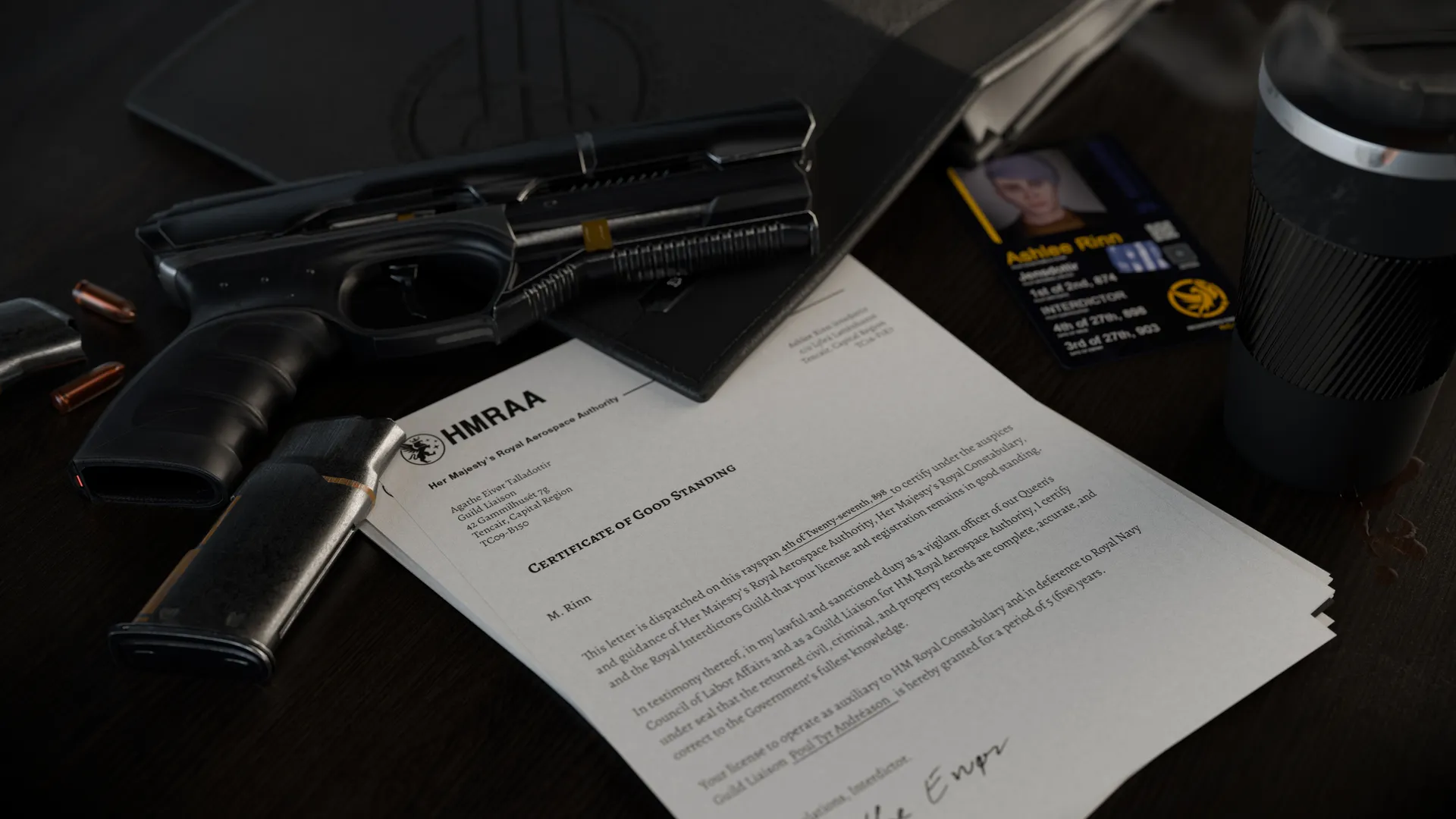
Re-entry itself is a non-trivial maneuver for any pilot, with ablative or magnetic shielding the only thing standing between a crew and a fiery death. Interdictors are never quite sure what they are going to find upon forcing a suspect ship to land; privateers and interdictors are the only civilians properly licensed to openly carry fully automatic firearms in the vast majority of jurisdictions. In need of close scrutiny, an interdictor’s charter is managed by their respective guild (Sibylean) or association (Leirean) in close liaison with the sovereign navy or local police force. They maintain their own cutters and are patched into airspace control systems. Interdictors are obliged to assist cooperative subjects by any means available, and they often face the inevitable hazards of search and rescue operations in hostile environments far from civilization.
Even with the full weight of greater authorities behind them should reinforcement be necessary, they are the first law officers on the scene, making interdiction an unpredictable and hazardous profession.
Militias
A cultural and historical artifact of the worlds of Sibyl, Celadon, Leire, and Sebek, militias are paramilitaries formed from civilian concerns. Militias are part-time volunteer operations, raised and called upon in times of need to protect a community and its territory.
The modern-day Sibylean militias are the reserve forces of royal and commoner houses alike, a legal and cultural remnant of how the galeres came together under the leadership of Queen Aveline at the conclusion of the Age of Variance. As the jarlé desired peace but were wary of full unification, the jarlja agreed upon a special dispensation in which each major house was to be allotted its own standing army. These forces were to act as a check and balance on the Royal Guard, which was restricted from growing its own forces beyond half the men tallied among all house regulars.
In time, these standing armies fell into disuse, but they remain as the Sibylean house militia. The twelve royal house militia are the best equipped and best trained; Sibylean readiness posture carried over from a brutal ancient history of conflict. The royal militias rallied and nationalized during the Novani-Sibylean War to good effect; quick communication between informants, spies, militia adjutants, and the Royal Navy saved several critical Sibylean orbital installations.
Sebeki militias historically played a key role in the world’s religious warfare, but these volunteer armies were transient and short-lived, always based on the dogma of the time. Rarely did these groups fight for the control of territory, but for hearts and minds. This sort of honorable ideological warfare had the unique consequence of minimizing non-combatant deaths. Most blood spilled on the sands of Sebek has been at the behest of clerics disinterested in the wanton slaughter of viable proselytes.
Celad militia have a complex history that dovetails with Maridean contact. Historians broadly agree that the Marideans ran shell games and double-dealt in order to play Celad interests and militias against each other, culminating in several internal conflicts that weakened their hand in trade and settlement negotiations. Though Celadon is a proud and fiercely independent province of the Novani Republic these days, the cynical history of first contact is not soon forgotten. The divide-and-conquer duplicity of First Minister Meinard Amonte and his cabinet is an understandably sore point for Celadonians, and some bristle at his namesake, as it remains bestowed upon the Republic’s capital.
Suggested reading 🡒

Small Arms
It's not that Voidfarers can't wield melee weapons. It's that at the expected combat ranges, they probably shouldn't.


Windsong Revealed (#2/3)
One trøllkvin of a voidrunner.