

Metrics & Time
Time travel is possible. You’re doing it right now. A background of timekeeping in The Bary.

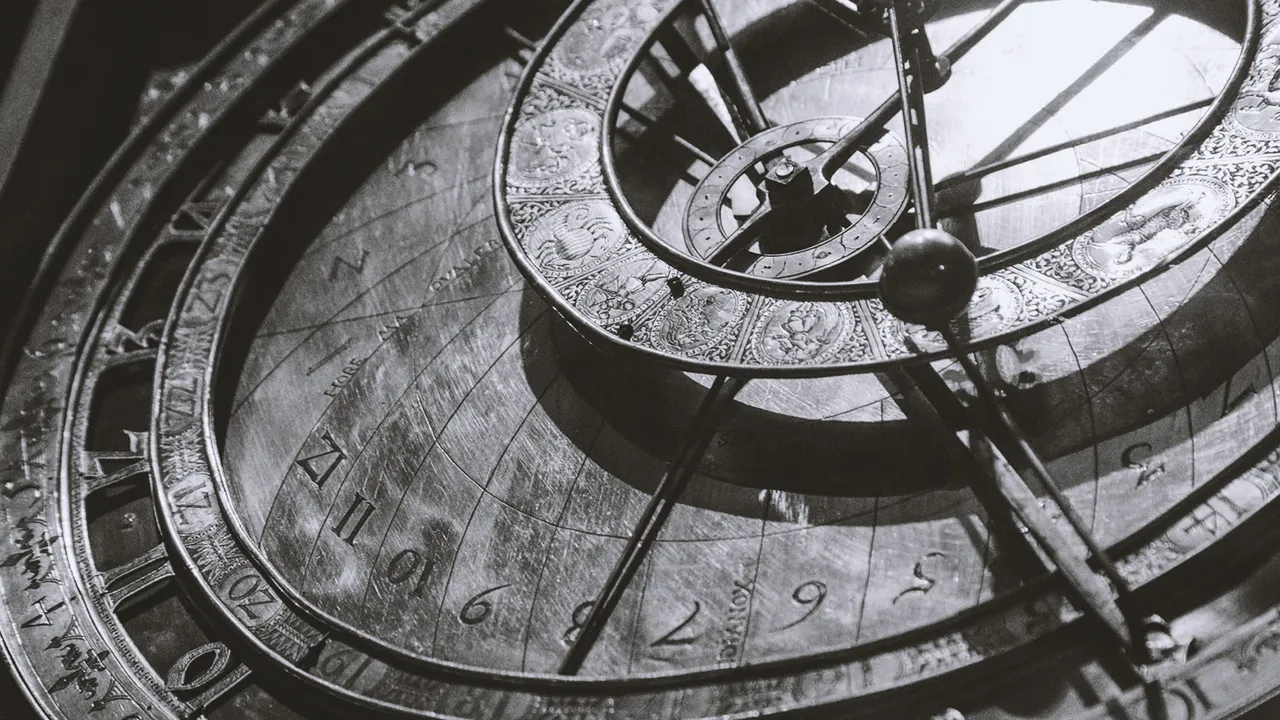
The Bary’s history of standardization is fraught with economic and political tension. It’s notable that throughout known history, the way humans measure quantities like distance, time, mass, volume, etc., changed markedly around radically new socioeconomic orders. For the facilitation of fair trade—and the taxation of that trade—governments, corporations, and individuals alike need to be on the same page. Rule of law and the very principle of equity otherwise collapse. If a seller hasn't labeled their goods with customary units, caveat emptor.
But regionally, it is convenient or even necessary to create new and novel abstractions. For instance, inhabited worlds do not all rotate at the same rate. Gravity is not the same everywhere, and so it became far more important to define mass than weight. Some fields, such as medicine, refer to complex legacy systems that must be understood by scholars. (For instance, assessing radiation exposure is a complex topic.)
Despite centuries or millennia of clever new weights and measures better suited to a particular environment, the Barystates all kept a complete record of Terran measurement systems. These include the base 10 metric system and the definition of the (kilo-)gram and the second. Seizing on this shared knowledge, and for the ease of communication and interstellar commerce, the Barystates came together to standardize its renewed use. Distance, mass, volume, etc. are carried over from ancient records. These measures are all quite simple to define.
But thanks to the eccentricities of the universe, there is no more relative measurement than time.
Time: The Most Relative Construct
The Congressional Calendar keeps the recorded Terran timekeeping system intact with a few truncations: there are no leap years, leap seconds, or variable days in a month. These eccentricities told historians much about the world(s) humanity came from, but were not as useful in the contemporary context.
Changes to the ancient temporal regime were made both for simplicity and as a compromise. Perhaps somewhat miraculously, every Barystate embraced a temporal metric in the antiquated clock and calendar it found useful. For example, a Maridean day is exactly 24 hours. A Sibylean orbit around Astrild is 60 of the moon’s gyres around Dowager, corresponding to 360 of these Terran and Maridean-like days, and adding up to what became a standardized year. On the other side of The Bary, the Geminese found that 30-day intervals corresponded with oscillations—librations—of Castor and Pollux when viewed from each other, important for religious observance. Meanwhile, the Empyreans were already using metric time, allowing them to keep the definition of the second.
The year was set to 1 upon the signing of the accords at the tediously named International Congress for Trade, Immigration, and Metrics. The novel Stardust takes place in 87 CY (Congressional Year 87).
There still exist several idiosyncrasies in timekeeping, a consequence of wide variations in the rotations and orbits of inhabited worlds, and the varied lifestyles of humanity.
Sleepless on Sibyl
Of The Bary’s inhabited worlds, Sibyl has perhaps the most complicated relationship with time, its days bisecting the natural human circadian rhythm.
Sibyl rotates about its axis slowly relative to the synodic facing of its host giant, Dowager. If Sibyl were much closer to Dowager, it would certainly be tidally locked, as all other interior moons of the Dowager system are. This gradual slowing of Sibyl’s rotation is as inevitable as entropy. The world’s mass and momentum ensure it will not meet Sebek’s fate any time soon, however. Once tidal locking occurs hundreds of millions of years from now, Sibyl’s synodic day will become infinite. An interesting consequence of Sibyl’s lunar orbit about Dowager is that while the days will become longer, the impact on its climate will be minimal compared to a standard planetoid.
In the Commonwealth, the number of years since Queen Aveline’s declaration of a matrilineal monarchy is counted. This calendar is simply referred to as the Royal Calendar, or the Royal Era (RE) in shorthand. The time before this seismic political event was coined the Age of Variance (AOV), a result of extensive internecine violence that brought the world’s population to its knees.
A gyre is the sidereal revolution of Sibyl around Dowager. One revolution of Dowager around Astrild is precisely a standard Congressional Year—it is standardized as such—and takes 60 gyres.
A rayspan is a Sibylean word for a day—more specifically one rotation of Sibyl about its axis—of which there are four in a gyre. A Sibylean rayspan is approximately 36 standard hours and one-quarter of a gyre. For sanity, a rayspan is split into three 12-hour sections called trines, which act as cultural morning, afternoon, and night. The capital Tencair keeps the universal coordinated time among Sibylean civil time divisions.
Sibylean dates are most often expressed as rayspan, then gyre, and finally the year. In common parlance, these first units are ordinal numbers, ie. “Second (rayspan) of Thirty-first (gyre), 850 RE.”
The concept of a Congressional standard day of 24 hours is a newer concept to Sibyleans, but corresponds to two trines and six days to a gyre.
The astronomical twilight hours on Sibyl are very long. The Sibyleans call the shining of Astrild upon their home raytime.
Further Considerations
In the Novani Republic
Maridean brights are the universal day throughout The Bary, 24 hours long. The words “bright” and “day” are used interchangeably in Novani parlance—and among biologists—to refer to the cycle of the human circadian rhythm. This natural oscillation is found in many plants and animals across The Bary, even on many worlds where the days are shorter or longer. This is further evidence that the flora and fauna beyond Maridea that follow this cycle were (in cosmic terms) recently transplanted from another world, and that their adaptation has been gradual.
In the Geminese Dominion
The trojan planets Castor and Pollux have rotational periods of 25 and 27 hours, respectively.
Besides using international standard time, the Lucian religion counts its religious years by the solar cycles of Lux. Specifying the beginning of a new cycle is a joint effort between the Lucian hierophant and astrophysicists, who closely monitor Lux. Days are separate for Castor and Pollux, which are always specified with a local reference for rotation, such as: the 420th Prime Polluci, Cycle 155.
In the Feronian League
There are many small states in the Saffron-Scarlet system, and a full accounting of the temporal eccentricities of each culture’s history is a volume in and of itself. Leire orbits its binary parent stars once every 36 days—10 orbits make a standard year. Sebek is tidally locked and only habitable along the Twilight Rim, where time seems to stand still. In recent years, the Feronians have more fully embraced international conventions in timekeeping.
In the Hold
Before it signed the international metrics accords, Empyrean Holdings used metric seconds to record the passage of time. Evidence of this will be clear to any visitor wandering the blue-collar or underclass streets of Hold space colonies. A kilosecond is 16.7 minutes, a megasecond is 11.6 standard days, and so on.
Among Voidfarers
The now hundred-year-old system of standardized Congressional time is the default among many corporations, organizations, and outfits that ply deep space and retain diverse crews.
Definition of a Light-Year
A light-year is the distance massless particles, such as photons, can travel in one year. This limit is an invariant physical constant of the universe and can be mapped to human notions of time to measure great distances. Because a standard Congressional year in The Bary is 360 days long, not the 365.25 days of ancient record, the Congressional light-year is a slightly shorter distance than The Bary’s ancestors once measured it. A Congressional light-year is a distance of 9,324,744,613,632 kilometers.
Suggested reading 🡒

Voidsuits Lore Primer
In the first of Stardust's lore primers for Voidfarers, Ashlee models her voidsuit while we discuss the finer points of life support in the vacuum.


Propulsion
How does one travel billions of kilometers? A big, effective, and barely controlled boom.